

Trendjacking and newsjacking are both about riding waves of attention, but they’re not the same wave.
And for savvy PRs and content marketers, understanding the difference is the key to choosing the right tactic, channel and timing.
Trendjacking vs newsjacking: the simple distinction
Put simply:
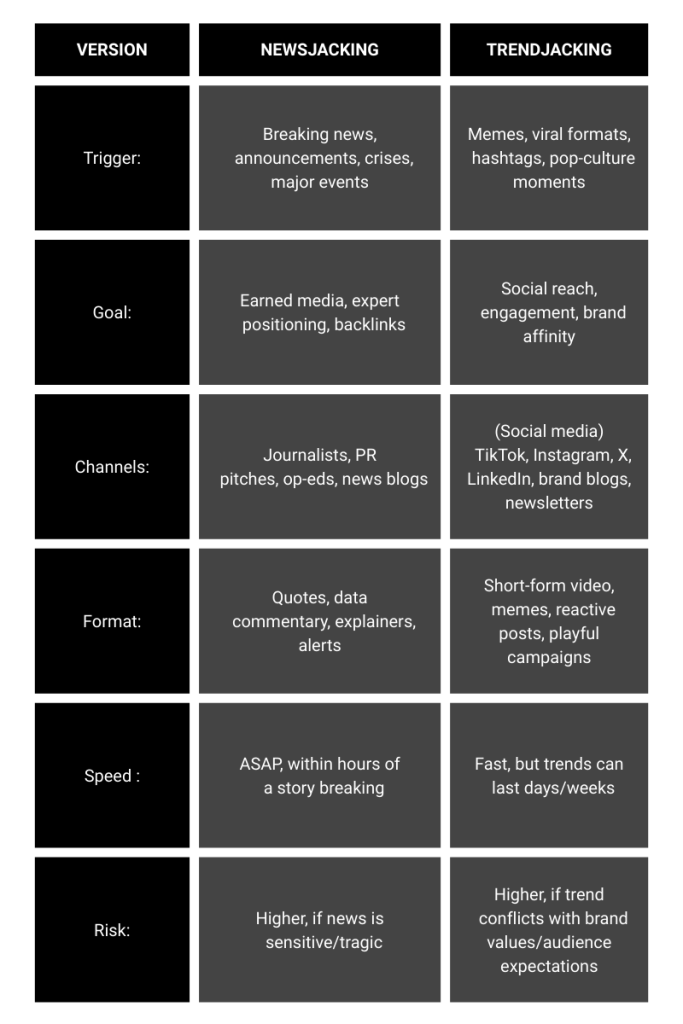
- Newsjacking is inserting your brand or expert voice into a breaking news story or time‑bound event to gain media coverage and authority. Think: “this is in today’s headlines, and we have a point of view that journalists can use”.
- Trendjacking is tapping into broader cultural or social media trends (think memes, formats, viral conversations) to boost reach and relevance, usually on owned and social media channels. Think: “this is all over TikTok/X today, and we can add a smart, on‑brand spin.”
So, in practice, newsjacking leans PR/media‑first, while trendjacking leans social/content‑first.
What newsjacking looks like (with examples)
At its core, newsjacking is about adding timely, expert commentary that makes a journalist’s job easier.
Classic newsjacking moves:
- Expert quotes into breaking stories
A PR team sees headlines about anticipated interest rate cuts and immediately offers their CEO to finance reporters to unpack what it means for local homeowners or SMEs. The brand “jumps into” existing coverage, rather than pitching a standalone story. - Data or explainer content to run alongside news
When a major policy change is announced, an SaaS or analytics company quickly publishes a simple explainer or data snapshot (e.g. “What this regulation means for Australian ecommerce retailers”), then shares it with journalists as a resource. - Fast‑turn opinion or bylined pieces
In response to a high‑profile tech outage or cyber incident, a security platform offers a quick-turn byline on “Three lessons for CISOs from today’s breach”, giving editors a fresh angle while the story is still hot.
Done well, newsjacking can deliver credibility spikes via media mentions, backlinks, panel invites and ongoing relationships with journalists who now see you as a go‑to expert source.
What trendjacking looks like (with examples)
Trendjacking borrows the momentum of what people are already sharing for entertainment or cultural relevance, then layers in your brand’s personality or message.
Social‑first, culture‑driven examples:
- Riding pop‑culture product moments
Heinz created “Ketchup and Seemingly Ranch” after fans noticed Taylor Swift eating chicken with ketchup and “seemingly ranch”, leaning into a meme that had exploded across social feeds. The product and content became part of a fan‑driven conversation, rather than a traditional campaign. - Tapping viral formats and sounds
Fast‑casual and QSR brands frequently adapt TikTok dance trends or audio clips to showcase menu items or brand quirks, boosting visibility because the algorithm already favours that format. Wendy’s using a TikTok dance to promote its Frosty is a typical example of using the format of the trend, while keeping the message brand‑specific. - Responding to social “moments of the day”
When a global IT outage caused by a CrowdStrike incident halted systems worldwide, Morning Brew published a snappy post (“POV: your weekend started early”) over a screenshot of the error message, echoing the internet’s collective frustration with humour. That’s trendjacking: referencing the moment in a social‑friendly way, not pitching IT reporters expert commentary.
Trendjacking is less about media coverage and more about grabbing a slice of attention in feeds your audience is already scrolling.
Where the lines blur (and why that matters)
Some PR pros use “trendjacking” as a synonym for newsjacking, especially in B2B tech, where “trending news items” and “industry trends” blur. But for practical planning across PR and social, it helps to separate:
- Object of response
- Newsjacking: specific, time‑stamped news events (election results, a data breach, a rate announcement).
- Trendjacking: ongoing viral themes (a meme template, a movie release craze, a recurring joke).
- Who’s responsible internally
- Newsjacking: PR/Comms pros, founders, spokespeople: the people who own the brand’s relationship with the media and reputation.
- Trendjacking: Social, Content, Brand marketing pros: the people who own engagement, reach and brand voice.
- Output
- Newsjacking: quotable lines in a journalist’s article, a pull‑quote in a broadcast segment, an op‑ed in business media.
- Trendjacking: a Reel, TikTok, meme post, reactive ad/carousel that makes your audience stop scrolling and think “they get it”.
While newsjacking is clearly the more obvious fit for the SourceBottle audience (since it’s about jumping on media call outs tied to today’s headlines), the same mindset (fast, relevant, value‑adding) can inform your trendjacking efforts on social as well.
How Sourcey subs can use both
For SourceBottle subscribers juggling PR, content AND social, the most effective strategy is usually a mix of both…but with clear rules of engagement.
Using newsjacking with media call outs
- Monitor journalist call outs or milestone events (as per our March calendar) for breaking topics/events aligned with your expertise (e.g. regulation changes, economic moves, legal decisions).
- Respond with tight, differentiated commentary: a clear stance, one useful stat and offer up one practical implication.
- Package that same insight on your owned channels as a short explainer or LinkedIn post, cementing you as the go‑to source, even after the news cycle moves on.
Using trendjacking on social and owned content
- Track trending themes, jokes and cultural releases your audience already cares about.
- Ask: “Can we add substance here?” If you can’t move beyond a weak pun, sit this one out. But if you can connect the trend meaningfully to a pain point your audience has or an insight, create.
- Close the loop with PR by turning successful trendjacked content into hooks for commentary. Eg. “We saw X explode on TikTok; here’s what it tells us about Y behaviour in B2B buyers.”
Conclusion
Trendjacking and newsjacking both ride attention, but they serve different strategic purposes.
Newsjacking builds authority. It’s fast, media-focused and rooted in adding expert value to a live, time-stamped story.
Trendjacking builds relevance. It’s social-first, culture-driven and designed to spark engagement in feeds your audience is already scrolling.
The true advantage comes from knowing which moment you’re in so you can ride that wave (safely) to the shoreline.
PS: Are you receiving free publicity opportunities, straight into your inbox?
No?!! (Wha?)